WWDC
A dedicated notebook for Apple platform season.
A place for session notes, experiments, photos, and the ideas worth bringing back home after Apple platform season.
Cupertino, June notes
Platform season as a working notebook, not a content dump.
Session fragments, labs, conversations, and the ideas that become easier to evaluate once they are connected to real product work.
Sessions & APIs
Notes from the platform layer.
The most interesting sessions are usually the ones that make production trade-offs visible.
SwiftUI navigation state
Interesting seeing how Apple keeps pushing toward more explicit ownership of navigation and state.
The APIs continue moving in a direction that feels much healthier for larger modularized apps, even if some trade-offs around coordination and deep linking still need careful handling at scale.
A recurring reminder throughout the week: simple demos and production navigation systems are very different conversations.
Foundation Models / on-device AI
A lot of the discussion around AI still focuses on generation quality.
What interests me more is operational behavior.
The most convincing demos were not the flashy ones. They were the workflows that quietly reduced friction without taking control away from developers or users.
- predictability
- latency
- privacy
- integration boundaries
- how these systems fit into existing product expectations
Performance sessions
One thing WWDC consistently reinforces: smoothness is still one of the most underrated product features.
Users might not describe it explicitly, but they immediately feel the cost of visual instability.
Performance is not polish. Performance is product quality.
- inconsistent frame pacing
- delayed feedback
- overloaded interfaces
- visual instability
Accessibility
The best accessibility sessions rarely feel like accessibility-only topics.
Good accessibility work tends to improve the product for everyone.
- hierarchy
- navigation clarity
- interaction consistency
- readability
- cognitive load
Notes & takeaways
Small observations from the week.
The useful parts are often fragments that change how a production trade-off feels.
The most useful engineering conversations often happen outside scheduled sessions.
Interesting seeing how many teams are independently converging on similar modularization and tooling problems.
A surprising amount of AI discussion now revolves around operational boundaries rather than raw capability.
Good developer experience compounds over time much more than people expect.
The best engineers I met this week were usually the calmest ones.
It’s always refreshing being around people who still genuinely care about software craftsmanship.
Seeing how indie developers work under tight constraints is often more interesting than large polished demos.
Architecture discussions become much healthier once people stop treating patterns like identity.
Experiments
Things to try while the ideas are still fresh.
Local LLM-assisted workflows
Exploring where local models actually help inside real engineering workflows.
Less interested in replacing engineering. Much more interested in reducing friction.
- repetitive tasks
- structured reporting
- debugging support
- CI visibility
- codebase navigation
SwiftUI architecture for smaller products
Trying to understand how much architecture smaller apps actually need before complexity outweighs clarity.
Still convinced restraint is underrated.
CI/CD and release confidence
Thinking more about the operational shape of releases.
The best tooling usually removes anxiety before it saves time.
- deterministic behavior
- reproducibility
- operational visibility
- reducing uncertainty during releases
On-device AI expectations
Curious how quickly user expectations will shift once AI features become local-first instead of cloud-first.
Feels like we are still very early here.
Conversations
The useful parts are not always scheduled.
Some of the best insights this week came from hallway conversations rather than official sessions.
Interesting seeing how differently indie developers and larger teams approach AI tooling.
A recurring theme across conversations: sustainable engineering matters more than constant optimization.
One of the best parts of WWDC is realizing how many people care deeply about quality, details, and craft.
Good engineering communities make difficult periods of your career feel much lighter.
The Apple ecosystem still feels unusually human compared to most tech spaces.
Photos & moments
A few fragments around the sessions.
Cupertino
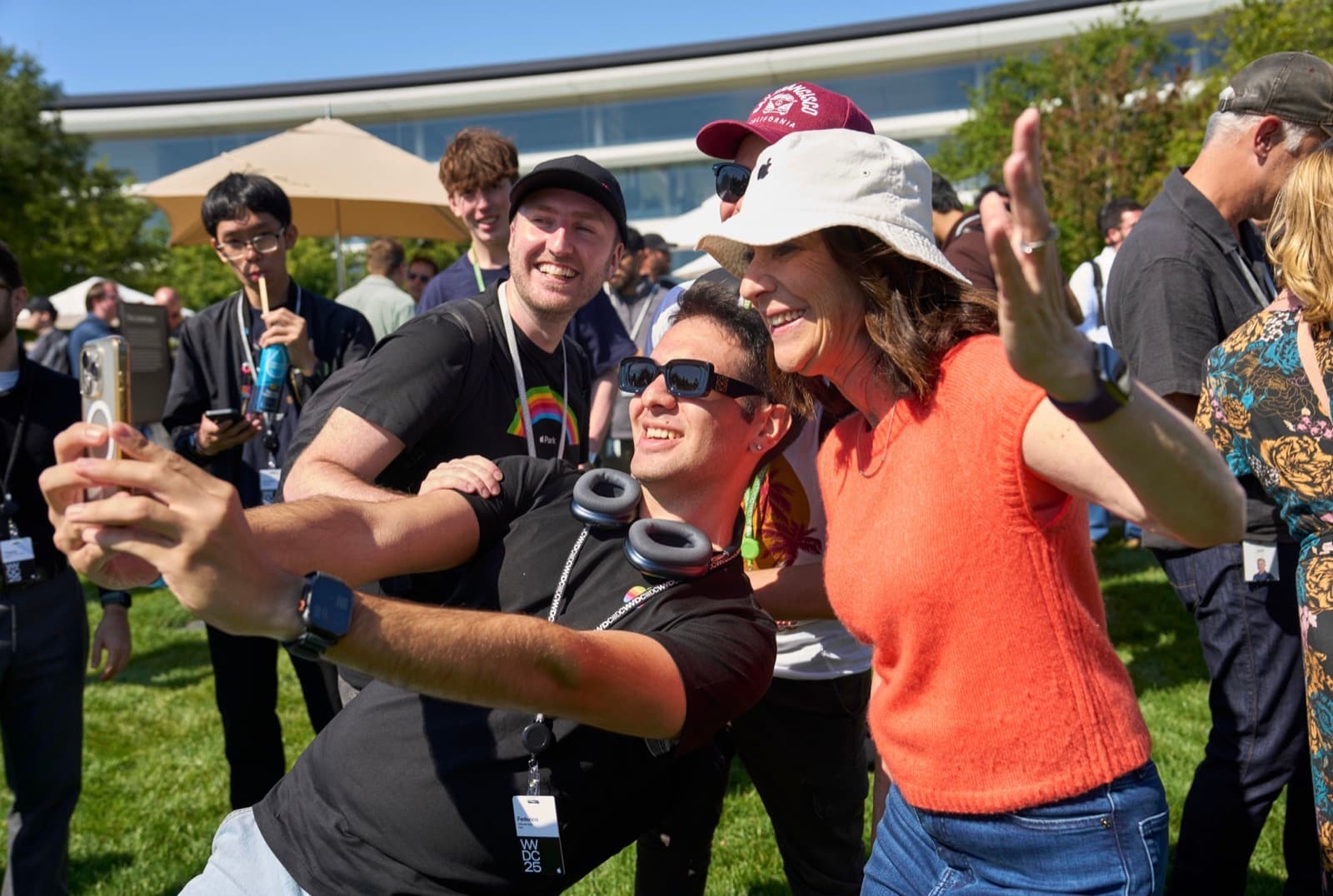
During WWDC, Cupertino starts feeling slightly disconnected from normal time.
Everyone is moving between sessions, labs, coffee shops, side conversations, and spontaneous meetups while trying to process an entire year of platform changes in a few days.
Between sessions
The engineering discussions usually continue long after the sessions end.
Some of the most interesting conversations happen outside labs, while waiting for coffee, walking between venues, or late at night after events.
Ecosystem
A good reminder that ecosystems are ultimately built by people.
Frameworks matter. APIs matter. But the part that stays with you is usually the people behind them.
Field notes
A list to come back to after the week ends.
Things I want to revisit after WWDC
- Foundation Models integration boundaries
- SwiftUI navigation ownership patterns
- local-first AI workflows
- reducing cognitive overhead in tooling
APIs worth experimenting with
- on-device intelligence APIs
- SwiftUI animation refinements
- observation/state ownership improvements
- developer tooling integrations
Ideas that changed my mind
- AI tooling becomes much more interesting under operational constraints
- developer experience discussions are increasingly becoming product discussions
- smaller, calmer software feels more compelling than feature-heavy products
Workflows that feel more realistic after seeing them in practice
- LLM-assisted debugging
- AI-supported documentation flows
- lightweight automation agents
- local model experimentation inside CI-adjacent workflows
Things worth remembering
- Momentum is useful, but clarity matters more.
- Most engineering problems become communication problems eventually.
- Sustainable systems usually outperform intense systems over long periods of time.